April 15, 2026
Why Learning by Doing Is More Effective Than Memorising
Your child can memorise facts. But can they apply them? Discover why learning by doing builds confidence, curiosity, and real-world problem-solving skills.

Your child can memorise facts. But can they apply them? Discover why learning by doing builds confidence, curiosity, and real-world problem-solving skills.
A classroom buzzing with activity, children building, experimenting, asking questions, and sometimes even making mistakes. Moments like these are becoming increasingly common at school open houses and events, where parents get a glimpse into how learning has evolved. If you are exploring international schools for your child, you may have noticed a shift away from rote memorisation towards something far more dynamic: learning by doing.
So why are more educators and parents embracing this approach? And what does it actually mean for your child’s growth?
What Is “Learning by Doing”?
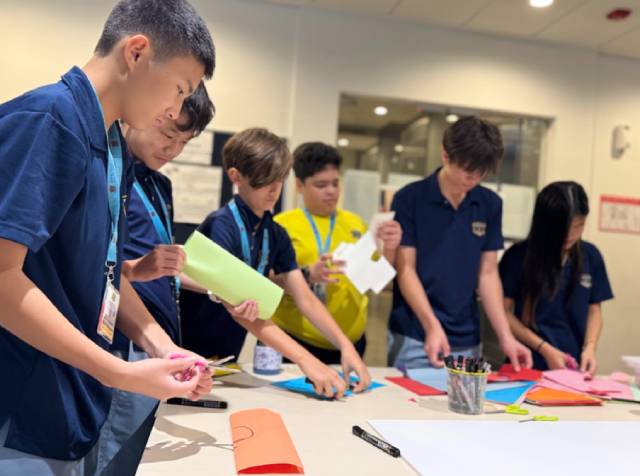
Learning by doing, often referred to as experiential or inquiry-based learning, is exactly what it sounds like. Instead of simply memorising facts, students actively engage with concepts through hands-on activities, real-world problem solving and collaborative projects.
Rather than reading about science, they conduct experiments. Instead of memorising formulas, they apply them to solve practical challenges. Instead of passively listening, they question, explore, and discover.
This approach is gaining traction across many international schools, especially those focused on nurturing well-rounded, adaptable learners.
Why Memorising Alone Falls Short
Memorisation has its place. It helps children recall essential information such as vocabulary, multiplication tables, or key facts. But when it becomes the primary method of learning, it often leads to shallow understanding.
Children may be able to repeat information but struggle to apply it in new situations. For example:
- A child might memorise a science definition but not understand how it works in real life
- They may solve textbook problems but feel lost when faced with unfamiliar questions
- They might excel in exams but lack confidence in problem solving
In a world that is constantly changing, these limitations can hold children back.
The Science Behind Hands-On Learning
Research in education and child development consistently shows that active participation strengthens learning.
When children engage in hands-on activities:
- Multiple senses are involved, which improves memory retention
- They form stronger neural connections by applying knowledge
- They develop critical thinking and problem-solving skills
Simply put, doing something helps children understand it more deeply than just hearing or reading about it.
Think about how a child learns to ride a bicycle. No amount of explanation can replace the experience of actually getting on and trying. The same principle applies to academic learning.
Building Skills That Go Beyond the Classroom
One of the biggest advantages of learning by doing is that it equips children with skills that extend far beyond academics.
These include:
- Critical thinking: Asking questions and analysing information
- Creativity: Exploring multiple solutions to a problem
- Collaboration: Working effectively with others
- Confidence: Learning from trial and error without fear
These are the very skills needed for the real world, where adaptability and innovation matter more than memorised knowledge.
Parents today are not just looking for good grades. They want their children to thrive in a complex, fast-changing world.
How Experiential Learning Looks in Practice
You might be wondering what this approach actually looks like in a school setting.
Here are a few examples:
1. Science Through Experimentation
Instead of copying notes, students design experiments, observe outcomes, and draw conclusions.
2. Mathematics in Real Life
Students apply mathematical concepts to budgeting exercises, measurements, or even building projects.
3. Language Through Expression
Rather than memorising grammar rules, children engage in storytelling, presentations, and discussions.
4. Integrated STEAM Projects
Subjects like science, technology, engineering, arts, and mathematics are combined into hands-on projects that mirror real-world challenges.
This kind of learning makes lessons more meaningful and memorable.
Why Parents Are Paying Attention
Parents are becoming increasingly aware that traditional methods alone may not fully prepare their children for the future.
Many are asking:
- Will my child be able to think independently?
- Can they adapt to new situations?
- Are they developing confidence and curiosity?
Experiential learning addresses these concerns by focusing on the whole child, not just academic results.
It is no surprise that many families exploring international schools are drawn to environments that prioritise inquiry, exploration, and active learning.
Seeing It Firsthand: The Value of Experiencing It Yourself
Reading about learning by doing is one thing. Seeing it in action is another.
Events like the Invictus STEAM Experience Day on 18 April 2026 offer parents a unique opportunity to step into this kind of learning environment. Children can participate in engaging, hands-on activities across science, technology, engineering, arts, and mathematics, while parents observe how lessons come alive.
It is often during these moments that the difference becomes clear. Instead of passive classrooms, you see students actively engaged, asking questions, collaborating, and genuinely enjoying the process of learning.
A More Meaningful Way to Learn
At its core, learning by doing is about making education meaningful.
When children understand the “why” behind what they learn, they are more motivated. When they are involved in the process, they take ownership of their learning. And when they are encouraged to explore, they develop a lifelong love for discovery.
This approach does not eliminate structure or discipline. Instead, it enhances them by making learning relevant, engaging, and purposeful.
Conclusion: Helping Your Child Thrive
Every parent wants to give their child the best possible start. Choosing the right learning environment plays a big role in shaping how your child thinks, learns, and grows.
If you are considering an education that goes beyond memorisation and focuses on real understanding, it may be worth exploring how inquiry-based learning works in practice.
At Invictus International School, students are encouraged to explore, question, and actively engage with their learning through a thoughtfully designed curriculum. The focus is on nurturing curiosity, building confidence, and helping children develop skills that will serve them for life.
Curious to see it for yourself? Book a school tour to experience how learning by doing can spark your child’s curiosity and love for learning.
An Institution by Sing-Ed Corporation.
© 2026 Invictus International School. All Rights Reserved.